St Hilary’s Feedback Process
1. Introduction
St Hilary’s Anglican Church is committed to fostering a community in which communication reflects the character of Christ—marked by truth, grace, humility, and love. An important part of this shared life is the ability to give and receive feedback well.
Feedback, when offered and received appropriately, is a gift. It strengthens our ministries, deepens trust, and enables growth. At the same time, unhelpful patterns of communication can lead to misunderstanding, frustration, and division. This document sets out how feedback and concerns may be shared in a way that is constructive, relational, and aligned with the life of the church.
2. Scope
This process applies to all who participate in the life of St Hilary’s Anglican Church, including ministers, staff, churchwardens, parish councillors, ministry leaders, those who serve, and members of the congregation.
3. Our Commitment
We seek to be a church in which people speak with honesty and kindness, and where feedback is both welcomed and handled with care. In keeping with the teaching of Scripture, we aim to speak in ways that build others up and contribute to the unity and health of the church.
This includes a shared commitment to addressing concerns directly, rather than indirectly, and to engaging one another in ways that are respectful, clear, and accountable.
4. The Nature of Feedback
Feedback may take a variety of forms. At times it is a simple observation or suggestion that can be received and acted upon easily. At other times it reflects a deeper concern or dissatisfaction that requires careful consideration and response. In some cases, what is initially expressed as feedback may in fact reflect a need for pastoral care.
Feedback is specific information, an observation or a perspective about something that has been said, done or experienced, offered with the intention of helping an individual, ministry or the church reflect, learn and improve. It may be positive or negative, and it does not need to include a suggested solution (though it may). Feedback should relate to something concrete and, wherever possible, be based on the person's own observations or experience. It is not gossip, speculation, hearsay about what others may think, or a general expression of dissatisfaction that does not identify a particular concern. Nor is it an opportunity for personal criticism or the undermining of others. Where a concern involves serious misconduct, harm or an allegation requiring investigation, it should be raised through the appropriate complaints or safeguarding process rather than treated simply as feedback.
For this reason, when feedback is offered, leaders will seek to understand what is being expressed and respond appropriately. Clarifying whether a matter is feedback, a complaint, or a request for pastoral support helps ensure that it is handled in the right way.
5. Giving Feedback Well
Members of the church community are encouraged to offer feedback in a way that is constructive and relational. Wherever possible, this means speaking directly with the person responsible for the matter, or with an appropriate leader, rather than sharing concerns broadly.
This approach reflects the relational wisdom of Matthew 18, which encourages direct and gracious conversation as the first step toward understanding and resolution.
Feedback is most helpful when it is specific, owned personally (rather than attributed to unnamed others), and offered with a willingness to contribute to a positive outcome.
6. Receiving Feedback Well
Those in leadership are expected to receive feedback with humility and care. This includes listening attentively, seeking to understand what is being said, and responding without defensiveness.
At times, feedback can be received and addressed immediately. At other times, it may require further reflection, consultation, or follow-up. Where appropriate, a record of feedback may be kept so that themes can be identified and addressed over time.
Leaders will seek, where possible, to communicate clearly about any outcomes or next steps.
7. Feedback Process
To support clarity, accountability, and consistency in how feedback is handled, the church maintains a feedback register. This register provides a simple record of feedback that has been received and is reviewed periodically by the Parish Council and Staff Team. This information is maintained in a secured part of the St Hilary’s MS Teams system and is only accessible by the Lead Minister and Churchwardens.
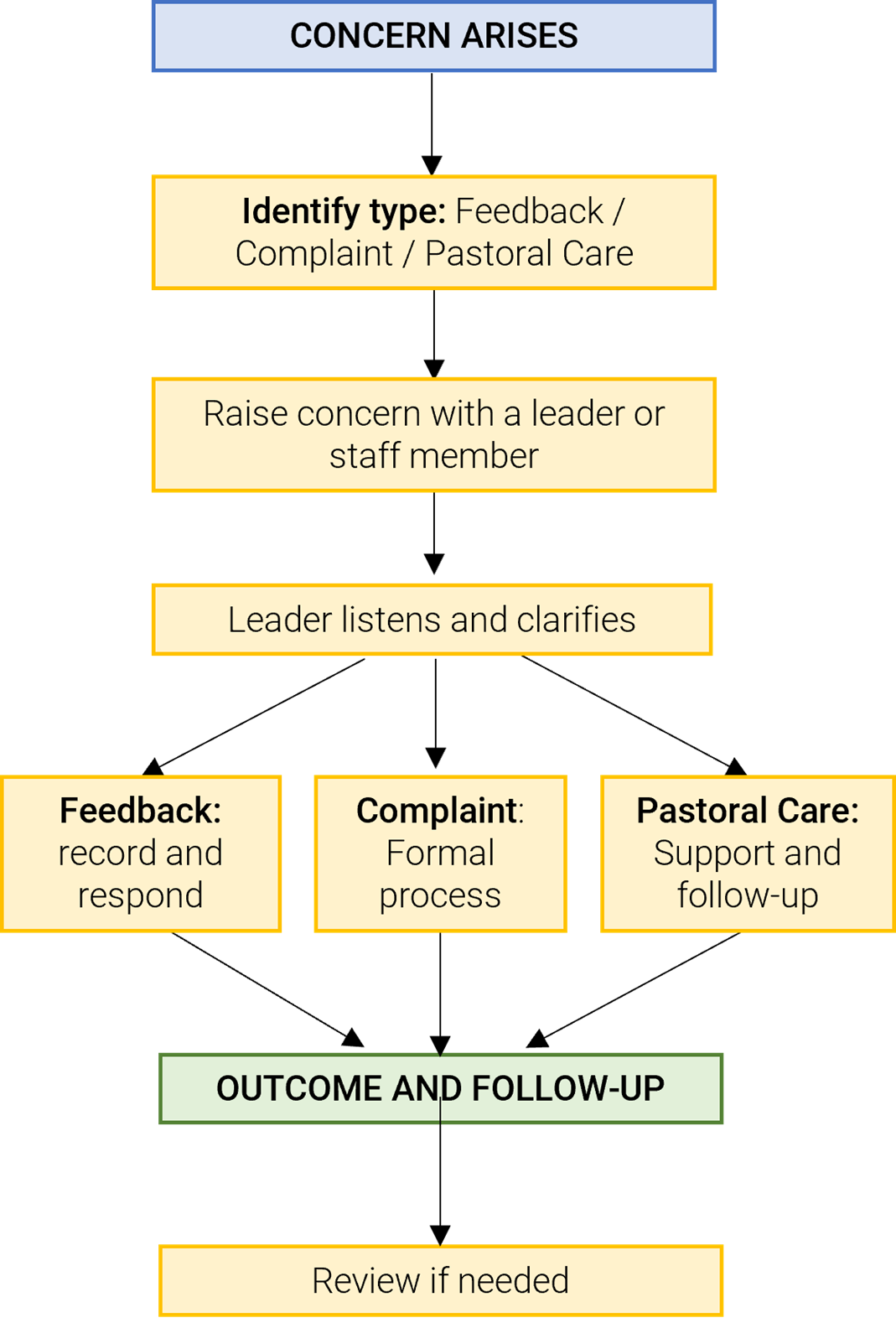
When feedback is received, the person receiving it will ordinarily seek to clarify the nature of what is being shared. This may include asking whether the matter is best understood as feedback, a complaint, or a request for pastoral care. This step helps ensure that the concern is responded to appropriately and through the most suitable pathway.
Where a matter is identified as a complaint, the church’s formal complaints process will be recommended as the appropriate avenue for addressing the concern. Where a matter reflects a need for pastoral care, support may be offered by the person receiving the feedback or, where more appropriate, referred to a member of the ministry team or pastoral care team.
The feedback register ensures that feedback is not lost, overlooked, or handled inconsistently. It records who has offered the feedback and the person responsible for responding, so that there is clear ownership of both the concern and the response. It also includes a brief summary of the matter raised, the outcome or resolution, and the date on which this outcome has been communicated to the person who provided the feedback.
In this way, the feedback process remains transparent, accountable, and pastorally attentive, while also enabling leaders to identify patterns or themes that may require broader consideration.
The diagram below outlines these steps.
8. Patterns of Unhelpful Communication
Not all communication assists the life and unity of the church. In particular, care should be taken with statements such as “many people are saying” or “lots of people think,” where no specific individuals are identified.
Experience shows that what can appear to be widely held feedback is often, in reality, a small number of people (sometimes as few as three or four) sharing the same concern with one another and then repeating it more broadly. This can unintentionally create an “echo chamber,” giving the impression of widespread concern where this may not be the case.
Such patterns make it difficult to respond clearly and can contribute to confusion or unnecessary anxiety. For this reason, feedback should be expressed personally and directly, rather than attributed to unnamed groups or circulated indirectly.
9. Responding to Concerns
When concerns are raised, leaders will seek to clarify the nature of the issue and determine an appropriate response. Some matters may be resolved through conversation and explanation. Others may require further consideration or referral. An initial response should be given within 2-3 days. In instances where multiple people need to be consulted it may take 2-3 weeks for the matter to be completely resolved.
Where a matter constitutes a formal complaint, it will be addressed in accordance with the church’s complaints process. Where a matter reflects a need for pastoral care, this will be prioritised and responded to with appropriate support.
10. Pastoral Care
At times, feedback or concerns arise from personal circumstances or experiences that require care and support rather than procedural response. In these situations, leaders will seek to listen with sensitivity, offer prayer and guidance, and ensure that appropriate pastoral support is provided.
Care will be taken to distinguish between pastoral conversations and formal complaints, while recognising that at times these may overlap.
11. Review and Oversight
This process will be reviewed quarterly by the leadership of St Hilary’s Parish Council to ensure that it continues to support healthy communication, effective ministry, and the unity of the church.
12. Final Encouragement
Giving and receiving feedback well is part of our shared discipleship. As we grow in speaking truthfully, listening carefully, and engaging one another with grace, we contribute to a church community that reflects the character of Christ and serves his purposes with integrity.
Contact details:
Telephone: 9816 7100
Email: feedback@sthils.com
Form: sthils.com/feedback
Postal: 12 John Street Kew VIC 3101
PDF copy available here.